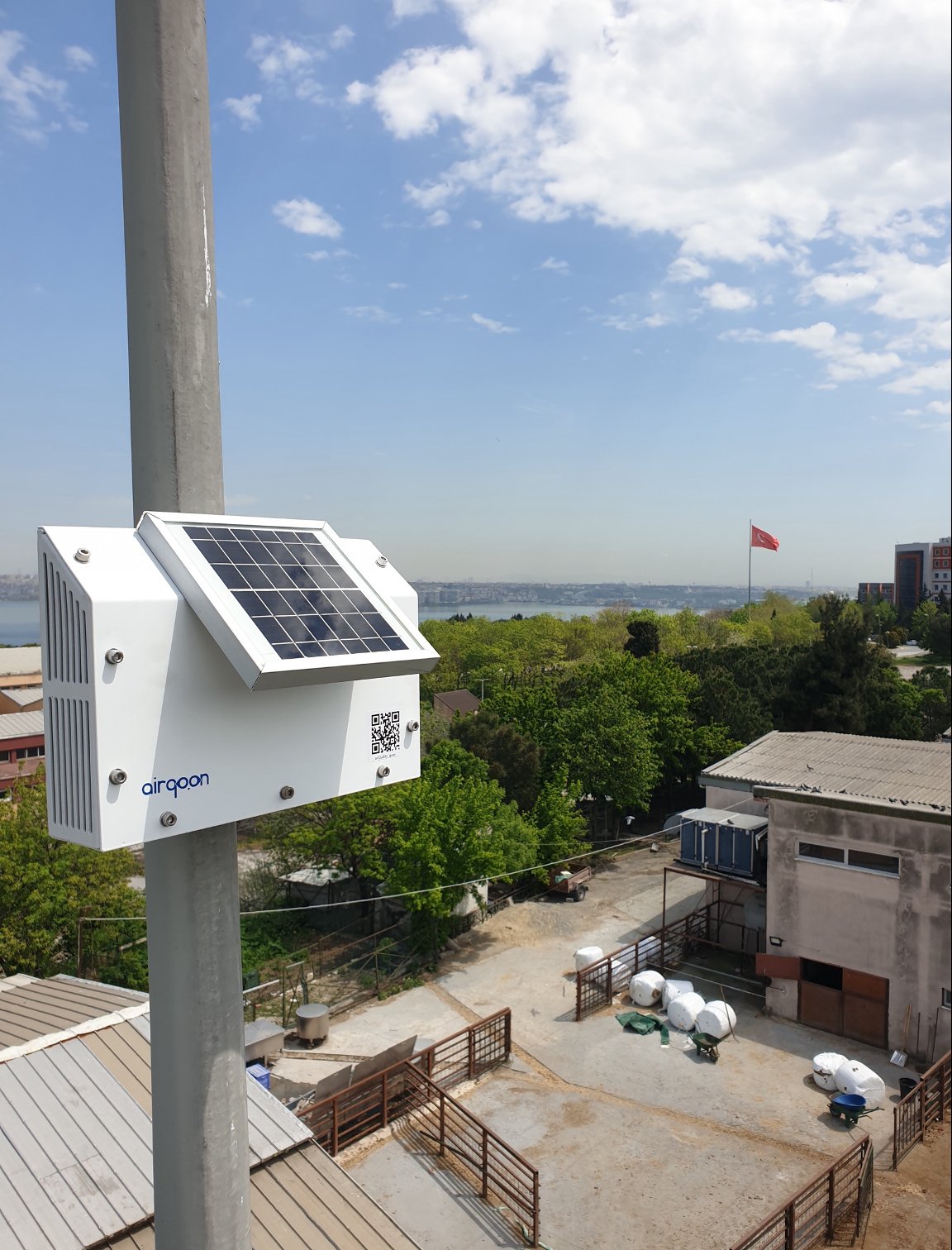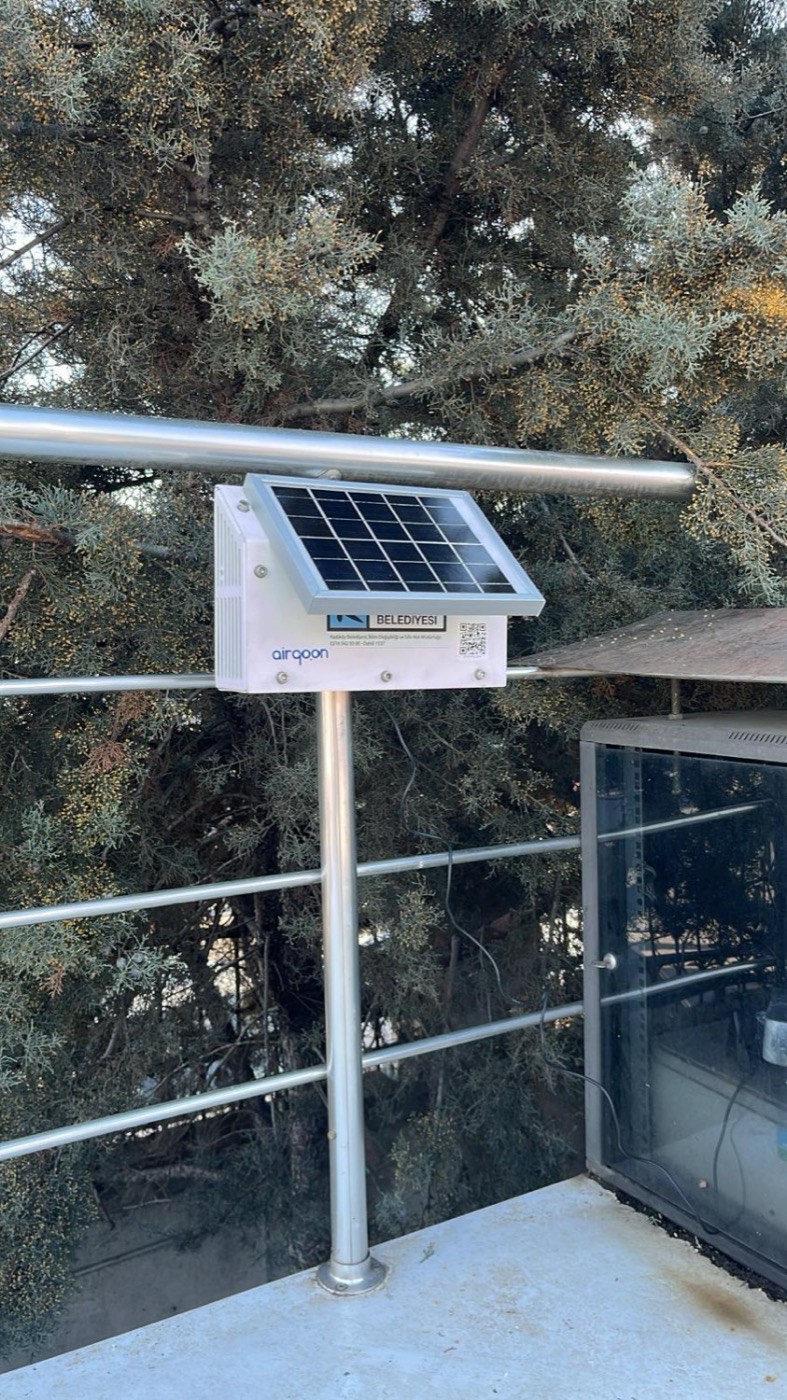
Unit L
A rugged, solar-powered outdoor station for ambient air monitoring at city and facility scale. Self-sufficient by design: no cabling, no infrastructure, installed in about five minutes.

Particulates, gases and meteorology
Every Unit L ships with particulate sensing and can be customized with up to 6 gas parameters, and enhanced later with external add-ons as your needs grow.
Particulate matter
PM1, PM2.5 and PM10 via nephelometric sensing, plus air temperature, humidity and pressure.
Gas configuration
NO, NO₂, O₃, SO₂, CO, with custom options including CO₂, H₂S, VOC, CH₄ and N₂O.
Modular sensor box
The sensor box is field-replaceable as a unit; servicing takes minutes on the pole, not a factory return.
Enhance in the field, as your needs grow
Every add-on connects to an installed Unit L on site: no redeployment, and data flows into Lens like any other parameter.

Anemometer
Wind speed and direction alongside every measurement: the input that turns concentrations into source direction on the perimeter.
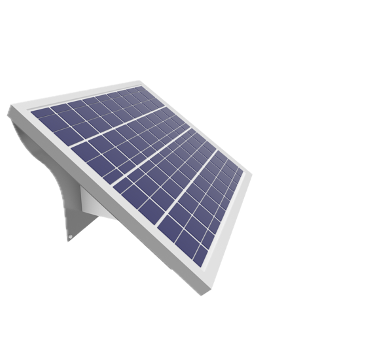
Extended Solar Package
Higher-capacity panel and battery for low-sun climates and heavier sensor configurations, fully off-grid, year round.
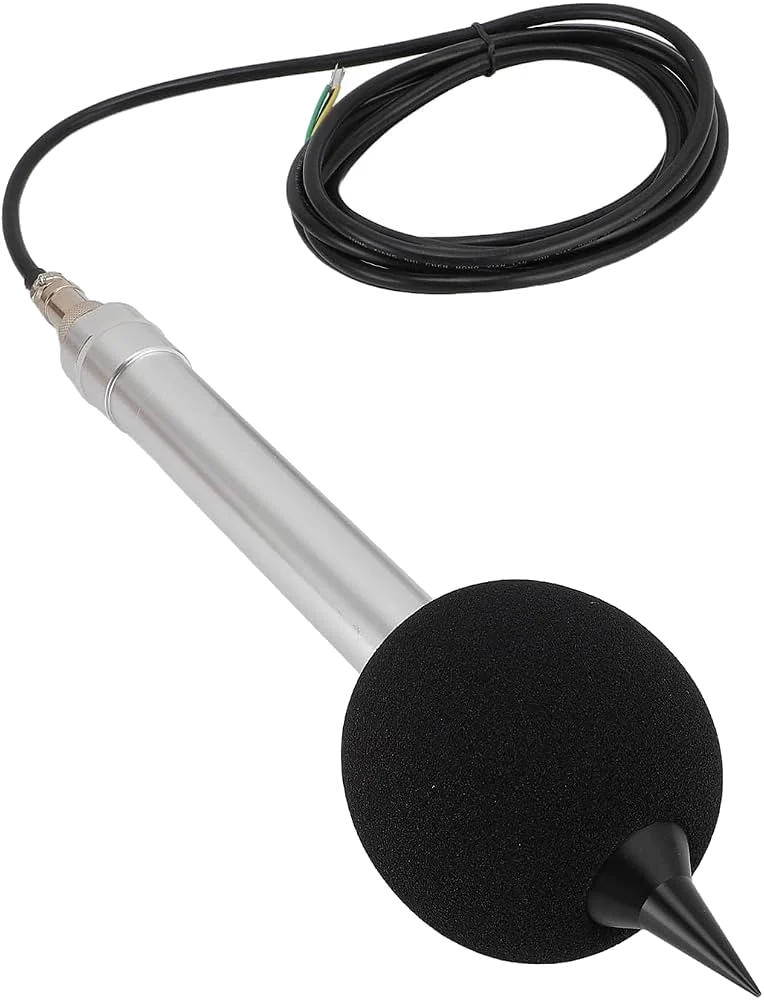
Noise sensor
Indicative noise on the same station for screening and hotspot detection. For regulatory-grade noise, see Class 1 noise monitoring.

Why teams choose Unit L
- Infrastructure-free. Solar power and cellular connectivity mean monitoring even in challenging geographic conditions.
- Cloud from day one. Works seamlessly with Airqoon Lens, with automatic alarms when limits are exceeded.
- Field-proven. Reliable in extreme heat, sub-zero cold and high-concentration industrial environments.
- Quality you can verify. Regular calibration procedures and advanced data-processing algorithms; validated through independent colocation studies.
Evaluated against reference stations
Unit L systems run co-located with regulatory reference stations, continuously as part of our own QA/QC and periodically for independent evaluation studies. The statistical analysis follows the CEN/TS 17660-1:2021 and -2:2024 methodology.
Time-series and scatter comparisons for PM2.5, PM10, NO₂, O₃ and CO are published openly; the full per-sensor report is available on request.
See the evaluation data
From city poles to refinery fence-lines